Mobile Brain Games blog
Memory Matching Strategies: A Worked Example
Follow a small illustrated card-matching example and see how previously revealed pictures can guide the next turn.
A practical matching strategy is to notice both the picture and its position every time a card turns over, then use that information when the same picture appears again. The goal is to make the next choice from what the board has already shown rather than turning over two completely unknown cards whenever a known pair is available.
Start by naming positions
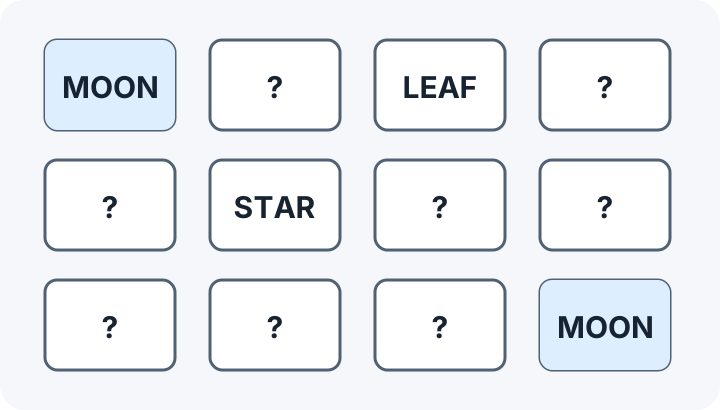
Imagine the three rows are called top, middle, and bottom, and the four columns are numbered from left to right. In the example, a moon has appeared at top-left. Another moon later appears at bottom-right, so those two positions form a known pair.
A leaf has also appeared at top-third, while a star appeared at middle-second. They did not match, but the turn was still useful: two pictures now have known positions.
Work through the next turns
- Take the known pair. Select the moon at top-left and the moon at bottom-right. There is no need to guess when both positions are known.
- Reveal one unknown card. Suppose the card at middle-left shows a star.
- Use the earlier reveal. Select middle-second, where the other star was seen. That completes another pair.
- Remember a miss. If a newly revealed picture has no known partner, note its row and column before it turns back over.
This approach does not guarantee the fewest possible turns. An unseen card is still unknown, and the order of the hidden cards affects the round. The method simply makes use of information the game has already revealed.
What mistakes make a board harder to follow?
- Turning over a known card first, then choosing an unrelated unknown card even though its partner is already known.
- Remembering only the picture and not its position.
- Changing position labels midway through a round.
- Rushing because a timer or score is visible, then overlooking an available pair.
For a shared game, one person can name the picture while another names the position. Keep the board size comfortable and change the difficulty if there are too many locations to discuss easily.
Try the worked approach
Play Memory Match in your browser to try the pair-finding format without installing an app. The Simple Memory Game product page explains the downloadable versions, while Card-Matching Games for Kids and Families covers rules and ways to take turns together.
Matching strategies describe choices inside a game. A score or completed board is not a diagnosis or a measure of everyday memory.