Mobile Brain Games blog
Pattern Memory vs Card Matching: Which Game Should You Choose?
Compare route-recall and picture-pair games by what you remember, how a round unfolds, pace, controls, and available platforms.
Choose pattern memory when you want to reproduce a route or sequence; choose card matching when you want to remember where individual pictures are hidden and find their pairs. Both are visual games, but a round asks you to hold different information in mind.
What do you remember in a pattern game?
A pattern-recall round briefly presents connected positions or an ordered route. After it is hidden, you reproduce the sequence. The order matters: starting and ending at the right points can be part of the challenge.
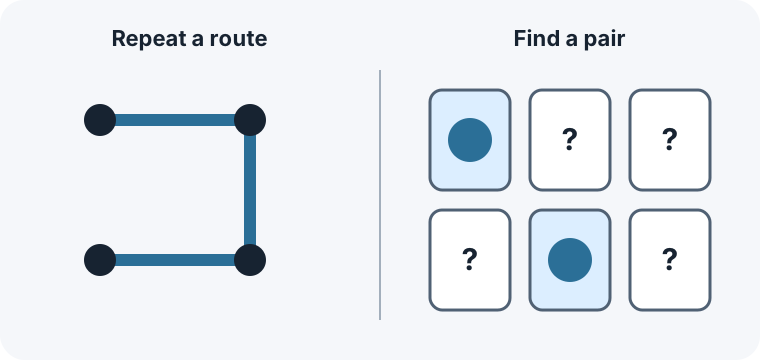
For example, look at four dots arranged in a square. A route goes top-left, top-right, bottom-right, bottom-left. Hide the route and draw it again in the same order. A longer route or shorter viewing time changes the difficulty without changing the basic rule.
Pattern Lock: Brain Games offers visual-pattern and number challenges on Android. Pattern Memory Games: How They Work + 5 Challenges to Try has more illustrative activities.
What do you remember in a matching game?
A card-matching round starts with face-down cards. Turn over two; a pair stays visible, while different cards turn back. The useful information accumulates as the round continues: each revealed picture may help with a later turn.
For example, if a circle appears in the first row and another circle later appears in the second row, remember both positions until you can select them together. The sequence in which cards were revealed matters less than knowing where each available pair is.
Simple Memory Game provides downloadable matching games, and you can play Memory Match online in a browser. The worked memory-matching strategy example shows how to use previous reveals.
How do pace and controls differ?
Pattern games often separate a viewing phase from a drawing phase. Matching games alternate between revealing cards and using the growing set of known positions. Pattern Lock uses a drawn route on Android; Memory Match uses taps or clicks on cards and has a browser option as well as mobile listings.
Choose the format whose interaction sounds more enjoyable. A player who likes reproducing one short route may prefer pattern memory. A player who likes uncovering a board gradually may prefer matching pairs. Difficulty settings, screen size, and pace can matter as much as the broad category.
Is one format better for your brain?
These pages describe gameplay, not a health comparison. Performance within either game can change with practice, board difficulty, familiarity, device, and the particular round. Choose based on the activity you want to play rather than treating either format as a medical or cognitive recommendation.
Ready to choose? Explore Pattern Lock for route and number challenges, or start Memory Match in your browser for picture pairs.